





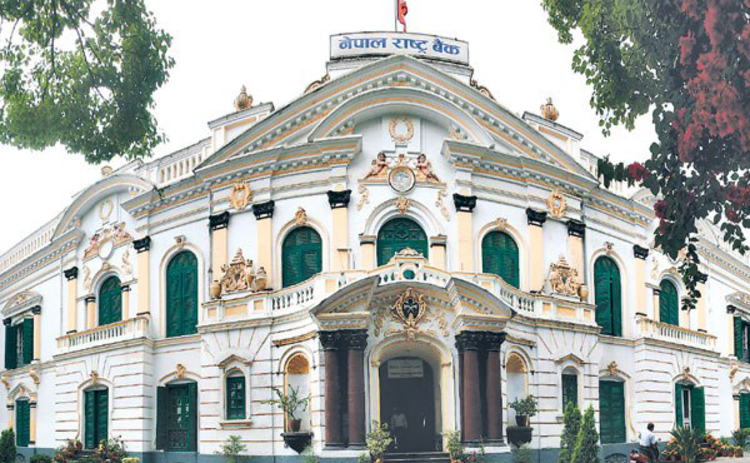
Kathmandu, July 11: The Nepal Rastra Bank (NRB) has completed preparations for the monetary policy for the upcoming fiscal year. The central bank will unveil the policy after its board of directors approves it during Friday’s meeting.
The proposed monetary policy was discussed in depth at the central bank’s management committee meeting on Thursday. The Board of Directors also held discussions on the policy’s preamble during the same day, according to a source at the NRB. “Since the board meeting was held late on Thursday, discussions focused on the policy’s preamble and the current economic context,” the source said, adding, “The policy framework will be finalized on Friday and released by the afternoon.”
The policy will be finalized through continued discussions starting early Friday, following up on Thursday’s board meeting, the source added.
At present, Nepal’s economy is sluggish. Despite low interest rates, credit demand remains weak. Meanwhile, the financial system is flush with liquidity, around NPR 800 billion in excess. Over Rs 600 billion, which the central bank had absorbed from the system, remains parked within the NRB. In this context, the central bank is formulating a monetary policy aimed at boosting credit demand and revitalizing the economy, the source said.
Since the fiscal policy already calls for increased credit flow, the monetary policy cannot diverge from that path. “As outlined in the budget, the monetary policy will naturally be accommodative,” the source explained.
The upcoming monetary policy is also expected to address budget-announced provisions such as loan restructuring, bad loan management through the creation of an Asset Management Company, and the establishment of a digital bank.
Given the decline in overall demand and the resulting contraction of businesses, the policy will also introduce provisions for extending working capital and interest waiver facilities to struggling industries and businesses.
The policy will support credit expansion in the private sector to stimulate the sluggish economy and will facilitate working capital loans based on sector-specific risks. Similarly, it will introduce concessional loan arrangements for microfinance borrowers facing financial stress.
Due to the stagnation in the real estate market, which has contributed to the slowdown in the economic cycle, the policy aims to reinvigorate the sector. “The management committee has decided to increase the loan ceiling for individual home loans and revise the collateral valuation limit,” said the source. “If the board does not amend this decision, there will be a boost in real estate transactions.”
Additionally, the loan-to-value (LTV) ratio for real estate loans, currently capped at 50%, is expected to be raised. At present, personal home loans can be issued up to NPR 20 million.
Provisions related to banks and financial institutions’ investments in the stock market are also expected to be slightly relaxed. The current rule requiring shares to be held for more than one year may also be eased. The source also noted that the central bank may reduce its policy rate, though the mandatory cash reserve ratio and statutory liquidity ratio are likely to increase.
Despite improvement in all economic indicators, overall economic activity remains stagnant. As a result, there is mounting pressure on the newly appointed Governor Bishwanath Paudel to adopt a more accommodating policy stance. Moreover, this year’s national budget has implicitly signalled the need for a looser monetary policy, further reinforcing the push for liberal measures.
Upon his appointment, Governor Paudel formed a banking sector reform task force led by former Securities Board Chair Dr. Rewat Bahadur Karki. The task force was given a one-month deadline and is set to submit its report to the governor this Sunday. It has recommended a liberal and prudent monetary policy in six key points.
Industrialists and business leaders have also criticized the central bank’s previous lending policies for hindering economic momentum. They have publicly called for a policy aligned with the budget that can energize the economy and boost domestic production.
If the board does not heavily edit the draft prepared by the management committee, a cautious yet expansionary monetary policy is expected to be announced, the source concluded.











Comments:
Leave a Reply