



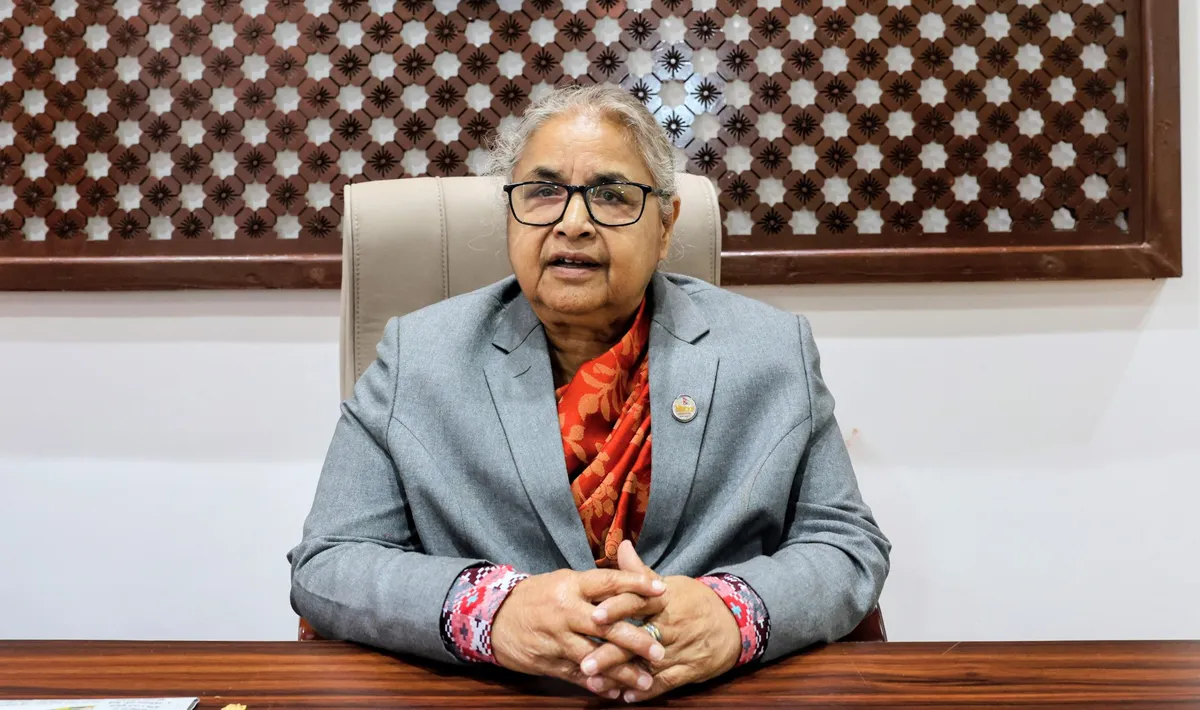
Kathmandu, Dec 4: Prime Minister Sushila Karki has presented six arguments defending her appointment and the dissolution of the House of Representatives in written responses to 16 writ petitions challenging both actions. The Supreme Court, led by Chief Justice Prakash Man Singh Raut with Justices Sapana Pradhan Malla, Hari Phuyal, Kumar Regmi, and Manoj Kumar Sharma, had directed the submission within seven days.
Karki’s first argument cites the constitutional need for a citizen-led government when political parties fail. She said the Gen Z protests created an extraordinary situation where the state machinery struggled to maintain peace and security, endangering public safety and the functioning of state institutions. Although forming a government from within parliament was the first option, political deadlock and citizen discontent made that impossible. In this context, she said, the constitution allowed for a citizen government under her leadership to maintain order and protect national interests. She added that the protests reflected not just youth voices but the broader aspirations of Nepal’s citizens, justifying her appointment and the subsequent dissolution of parliament.
Second, she invoked the principle of necessity. Karki argued that her appointment and the dissolution were essential to uphold citizen supremacy and protect national interest. She noted that when political parties fail to resolve crises, extraordinary measures become legitimate, even if they fall outside normal constitutional provisions. This, she said, grants legality to her actions under the principle of necessity.
Her third argument stresses that political decisions are not for judicial review. Karki emphasized that appointing a prime minister and dissolving parliament are political questions, and courts traditionally avoid intervening in such matters. She cited precedents in Nepal and abroad, including India and the U.S., where courts refrain from adjudicating political disputes.
Fourth, she stressed the broader interpretation of the constitution. Karki argued that constitutional provisions should be understood in the context of constitutional traditions, ethical norms, and political realities, not merely as written text. Extraordinary circumstances, she said, require dynamic interpretation guided by political constitutionalism to find practical solutions.
Fifth, she addressed the challenge regarding her eligibility under Article 132. She argued that in exceptional circumstances following the protests, her appointment as a former judge was justified to resolve political deadlock. In such crises, the political acceptability of an individual outweighs formal restrictions.
Finally, Karki justified parliament’s dissolution due to the inability of existing political structures to provide a government accountable to the people. She contended that the legislative body had failed to deliver governance, necessitating intervention to restore stability, uphold the rule of law, and safeguard citizens’ rights.
People’s News Monitoring Service
\








Comments:
Leave a Reply