




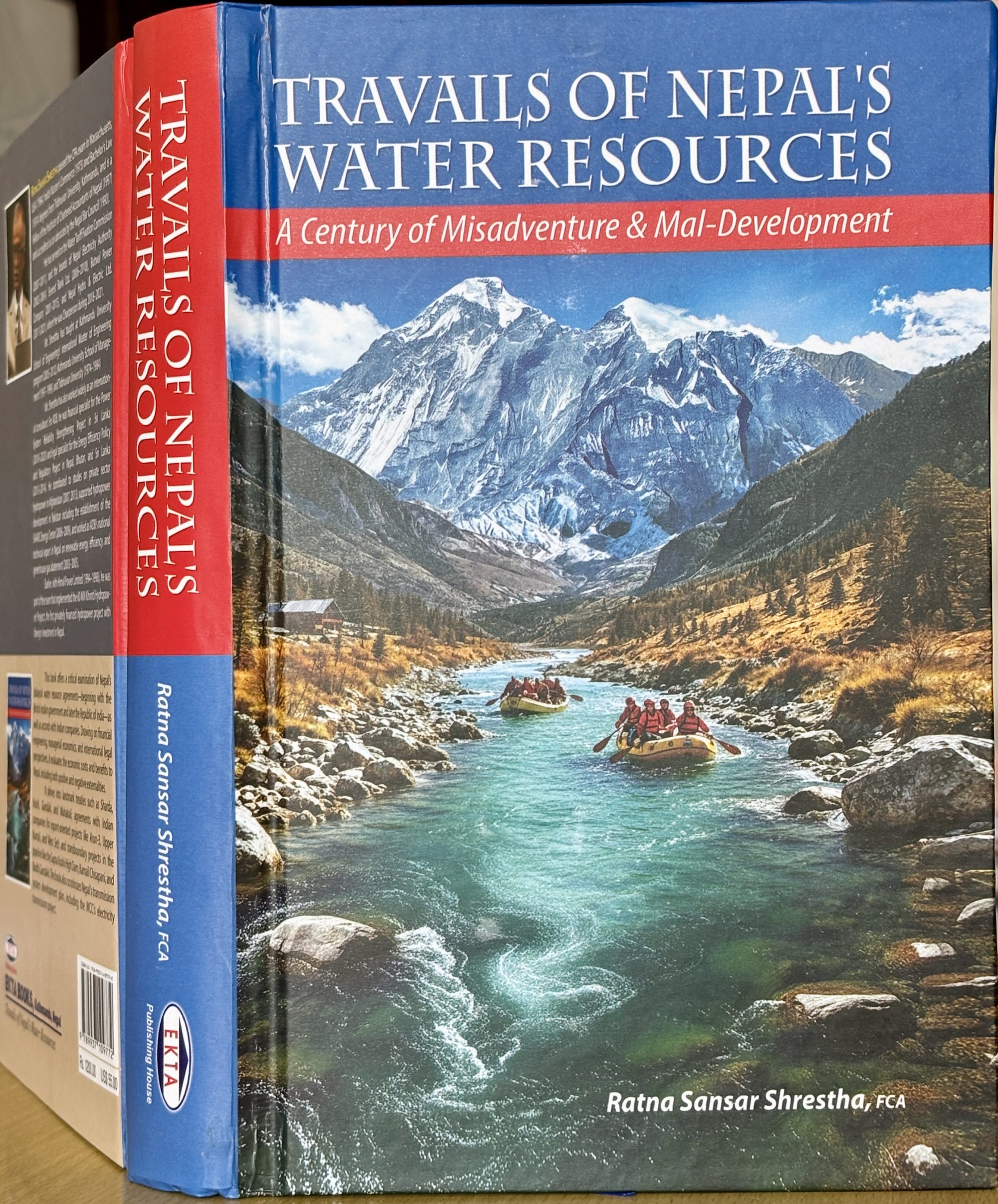
Kathmandu, November 9 — A new book by noted water resources expert Ratna Sansar Shrestha, titled “Travails of Nepal’s Water Resources: A Century of Misadventure and Maldevelopment,” was launched amid a special function held in Kathmandu today.
Chief Justice Prakash Man Singh Raut unveiled the book, which is expected to serve as a valuable reference for students, researchers, and policymakers. The publication traces the century-long history of water resource development in Nepal.
Highlighting the significance of the book, Chief Justice Raut said that water is intrinsically linked to a nation’s very existence. “Either we have failed to realize the value of water, or we have deliberately neglected it,” he remarked. Raut emphasized the need for the optimum utilization of Nepal’s water resources, adding that “only the true sons and daughters of the soil can make this possible.” He further noted, “We must never forget that this nation belongs to us — it is in our hands to build it.”

Former Secretary at the Ministry of Water Resources, Bhuvnesh Kumar Pradhan, praised the author’s dedication, stating that the book is the result of rigorous research and hard work. He noted that all treaties and agreements related to water resources have been included and critically analyzed, making the work highly valuable.
Professor Dr. Prachanda Pradhan echoed similar sentiments, commending Shrestha’s meticulous effort in compiling and analyzing historical data. “Nepal holds immense potential in water utilization,” he said, “but perhaps due to a lack of understanding, we have been unable to harness it effectively.”
Former Minister Dipak Gyawali, who wrote the foreword to the book, described it as a comprehensive documentation of 100 years of Nepal’s water resource history. “This book will serve as an important reference not only for professionals in the sector but also for the Gen-Z generation and newcomers interested in understanding Nepal’s hydro-development trajectory,” he noted.
In his remarks, author Ratna Sansar Shrestha, a chartered accountant by profession and a long-time researcher on water economics, criticized the prevailing notion of generating hydropower solely for export. “The idea of producing hydropower for foreign markets to earn money is fundamentally flawed,” he argued. “If we consume the energy domestically, we can generate far greater economic value than what we earn through exports.”
Shrestha proposed utilizing hydropower for activities such as Bitcoin mining and data processing, which would yield higher returns. Citing an example, he stated, “Nepal earned only Rs. 17 billion from hydropower exports, whereas if we used that same energy for Bitcoin mining, our potential earnings could reach up to Rs. 3 trillion. We will never become prosperous by exporting electricity.”
Shrestha remarked that policymakers tend to view rivers solely as sources of hydropower, whereas in reality, they are intrinsically connected to drinking water, irrigation, tourism, and even the foundation of civilization itself.
He further announced that all proceeds from the sale of the book would be contributed to the nation.
Published by Ekta Books Distributors, Travails of Nepal’s Water Resources is priced at Rs. 950 (US$ 45) for the standard edition. The 572-page volume is divided into six parts and 25 chapters, offering an in-depth exploration of Nepal’s hydropower journey, policy failures, and future possibilities.







Comments:
Leave a Reply