



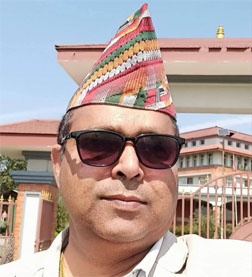
By Shambhu Prasad Deo
Nepal is a nation shaped by diversity of people, languages, cultures, geography and historical experiences. This diversity has long been the country’s defining strength. Yet today, it often symbolizes as a source and ground of division, particularly in debates surrounding identity-based federalism. The real challenge before Nepal is not whether identity should be acknowledged, but how it can be accommodated while strengthening national unity and democratic governance.
The demand for federalism did not emerge in isolation. It grew out of decades of centralized governance, uneven development and exclusion from state power.
Communities in the Madhesh, indigenous nationalities, Dalits, women and other marginalized groups have consistently sought dignity, representation and equitable participation. In this sense, identity is not a call for separation; it is a call for recognition and justice within the state.
At the same time, legitimate concerns exist. International experience shows that federal structures built solely on ethnic or identity lines can be fragile if democratic institutions are weak. The collapse of the Soviet Union is often cited in this context—not because federalism itself failed, but because excessive central control, lack of accountability and deep mistrust between the center and constituent units undermined the system. Nepal must learn from such lessons without drawing simplistic parallels.
Nepal’s path lies in civic-based federalism—a model that ensures full cultural, linguistic and social rights while preserving territorial integrity and a shared national identity. Identity can be meaningfully protected through language rights, inclusive education, cultural autonomy and decentralized governance, without turning provinces into exclusive enclaves. Unity, after all, is strongest when citizens feel respected with ownership over ongoing affairs rather than coerced.
Federalism, however, is not merely about drawing new boundaries. It is fundamentally about restructuring power. Without real devolution of authority and resources, federalism risks becoming symbolic. This is why fiscal decentralization is critical. Responsibilities must be matched with adequate resources at every level of government.
Local governments should be empowered-and properly funded-to manage school education, basic healthcare, social protection and local infrastructures. Provinces should focus on regional connectivity, industrial development, higher education, technical trainings and specialized health services. The federal government, in turn, must concentrate on national security, foreign policy, macroeconomic stability, disaster management, national or interprovince highways, infrastructures, and setting national standards. Such a division of roles improves accountability, transparency and development outcomes.
Nepal’s economic model also requires urgent rethinking. Heavy dependence on remittances and import-based taxation has sustained consumption but weakened domestic production. A resilient future demands a shift toward a production-based economy that generates employment at home.
In this transition, Madhesh can play a transformative role. With fertile land, strategic location and a young workforce, the region has the potential to become Nepal’s hub for agro-industries—including food processing, storage, packaging and value-added agricultural exports. Linking farmers directly with agro-processing industries can raise incomes, reduce post-harvest losses and strengthen food security.
Equally important is the integration of education with employment generation. Technical schools, vocational institutes and universities in the Madhesh must align curricula with market needs—agro-technology, manufacturing skills, logistics, information technology and entrepreneurship. Education should not merely produce certificates, but employable skills and innovators.
The expansion of industries and information technology in the Madhesh is also essential. Industrial corridors, special economic zones, and IT service hubs can absorb skilled youth who currently migrate abroad for work. Reliable electricity, digital infrastructure and predictable regulations can attract private investment and foster innovation. When education, industry and technology are linked, employment follows.
Beyond the Madhesh, regional specialization can drive balanced growth. The hills and mountains can leverage tourism, hydropower, livestock and high-value agriculture. Urban centere can expand education, health services, finance and digital industries. Harnessing such comparative advantages coupled with fiscal decentralization of budget allocation of 32, 33 and 35 percents to federal, provincial and local governments respectively can realistically push Nepal’s growth rate beyond seven percent in a sustainable manner.
No political or economic reform can succeed without addressing social challenges, particularly those affecting youth. Drug abuse has emerged as a serious public health and social issue in parts of the Madhesh, driven by unemployment, social stress and easy cross-border access to narcotics. Addressing this crisis requires more than policing. It demands integrated responses- credible responses from the governments, quality education, job opportunities, skill development, accessible rehabilitation services and active community engagement.
Debates on Nepal’s republican system should focus on institutions rather than personalities. Historically, centralized power weakened accountability and reduced citizens to subjects. A republic, when properly institutionalized, ensures equality before the law and citizen ownership of the state. Any proposal that concentrates executive power-such as a directly elected executive without robust checks-must be examined carefully to safeguard democratic balance. Different power centers in a diverse country like Nepal can be best suited. Separate policy making and implementing institution can reduce policy corruption drastically.
Ultimately, Nepal does not need extreme nationalism, nor does it need unchecked identity politics. What it needs is inclusive nationalism-a shared commitment to a state where every citizen feels represented, respected and responsible. The people of the Madhesh or indigenous people do not seek privilege; they seek fair participation in governing the country and contributing to its progress.
Nepal’s future must be shaped by democratic institutions, economic development institutions, productive economic transformation, fiscal decentralization for optimum resource sharing, and social inclusion-not by division or dependency. Strengthening federalism through accountability, empowering regions through production and employment, and nurturing unity through respect offer a practical and hopeful way forward.



Comments:
Leave a Reply