




By Govinda S. Pokharel
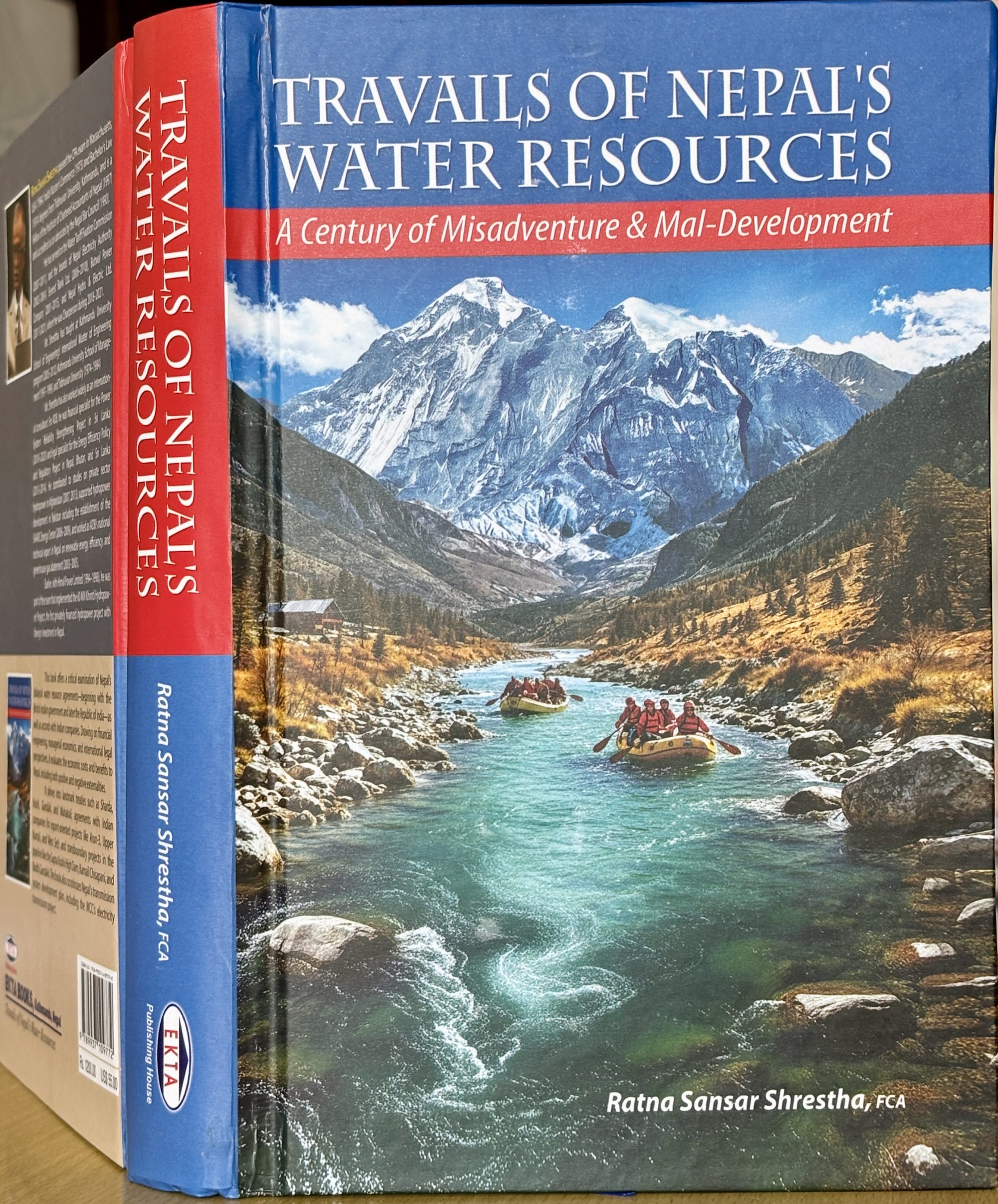
Travails of Nepal’s Water Resources, authored by Ratna Sansar Shrestha, FCA, and published by Ekta Books in 2025, is a timely and provocative intervention in Nepal’s long-standing debate on water governance. Written in English, the book critically examines Nepal–India water treaties, project development agreements (PDAs), and what the author views as an unjustified rush toward large infrastructure—particularly hydropower projects.
The book sets out three clear objectives: first, to analyze Nepal–India treaties on water resources; second, to scrutinize memoranda and PDAs signed between the Government of Nepal and Indian companies; and third, to question the haste with which hydropower projects are being pursued in Nepal. Structurally, the book is divided into six parts and twenty-five chapters, moving from an overview of Nepal’s water sector to detailed treaty analysis, legal aspects, conclusions and policy recommendations.
Based on World Bank data presented in Table 2 (p. 34), Nepal’s per capita water availability is reported as 6,753 m³. However, using the commonly cited estimate of Nepal’s annual water availability of 225 BCM and a population of 29.61 million, per capita water availability should be approximately 7,599 m³. This suggests an inconsistency between the reported per capita figure and the underlying aggregate water availability and population data. Moreover, recent estimates indicate that the total annual volume of water available in Nepal is significantly higher. Govinda S. Pokharel estimates Nepal’s total annual water availability at 336.76 BCM (Nepalma Barshik Kul 225 Hoina, 336.76 Arba Ghana Mitar Pani Upalabdha, Jalsarokar, 17 September 2025, https://jalasarokar.com/news/nepal-has-a-total-annual-water-availability-of-336759-billion-cubic-meters-not-225-3771). On the basis of this figure, Nepal’s per-capita water availability would be 11,373.15 CUM. This discrepancy suggests that the data presented in the book underestimates Nepal’s actual flood water availability and, consequently, its per-capita flood water. This, however, requires closer scrutiny. More importantly, the very concept of “water abundance” must be treated with caution in Nepal as most of the water is available during the monsoon in the form of floods, often causing destruction rather than prosperity. Overabundance, in this context, is a liability not an asset—unless floodwaters are effectively converted into usable water resources that can contribute to national interests.
The principle related to rights over river water, discussed on page 43, refers to the Harmon Doctrine or the principle of absolute territorial sovereignty, which grants a state complete rights over the water flowing within its territory. Under this doctrine, Nepal would theoretically possess full rights over its river waters. However, in practice, this principle is widely opposed. The World Bank does not accept absolute territorial sovereignty, and this opposition has affected financing of projects such as Upper Arun, where the Bank did not support Nepal’s position. Instead, the World Bank appears to operate on the principle of “might is right,” a view that is also shared by Nepalese politicians who are eager to concede water rights and promote storage projects that are in the interest of the downstream neighbor.
The author further argues that Nepalese bureaucrats, both past and present, perceive Nepal as a water-rich country and therefore feel little urgency to conserve or optimally utilize water resources in the national interest. In contrast, India perceives itself as water-scarce and actively seeks access to water resources, including those originating in Nepal and China. This imbalance is evident in all bilateral water treaties, beginning with the 1920 Sarada Treaty, followed by the 1954 Kosi Treaty, the 1959 Gandak Treaty, and most notably the 1996 Mahakali Treaty.
Shrestha convincingly fulfills the first two objectives. His critique of Nepal–India water treaties or agreements—from the Sarada Treaty of 1920 to the Mahakali Treaty of 1996—is rigorous and unsettling. These agreements, often downplayed by Nepalese political elites, have long-term implications for Nepal’s overall sovereignty including sovereignty over its water resources. In my view, such treaties and agreements are fundamentally illegitimate and reversible, as none of Nepal’s constitutions grant authority to enter into long-term water agreements that constrain future generations more so if such treaties/agreements are debated beyond the umbrella of the Nepalese Law.
The author’s criticism of PDAs signed with Indian companies is particularly strong. As Shrestha rightly observes, very few politicians, bureaucrats, or members of the intelligentsia fully understand the ramifications of these deals. This lack of comprehension, combined with political expediency, has resulted in agreements that have found to prioritize downstream interests over Nepal’s long-term national benefit.
On the third objective—the rapid expansion of hydropower projects—I fully share the author’s concern. Nepal is investing scarce public and private capital in generation projects that cannot be evacuated to the grid on time and cannot be absorbed by domestic demand. Developing hydropower primarily for export, while domestic consumption is kept limited, raises serious questions about development priorities as well as government’s national integrity.
I differ sharply with the author’s repeated assertion that Nepal’s true natural gift lies not in water itself but in its topography and geology. In reality, Nepal’s water resources and topography are inseparable, and the country’s fragile geology poses significant challenges rather than advantages. Water, when combined with topography and wisely managed, is Nepal’s real endowment.
Recognition of Mahakali as Boundary River:
Despite the explicit stipulation in Article 5 of the Treaty of Sugauli that the boundary between Nepal and India lies along the western bank of the Mahakali River, the author appears unduly inclined to extend the benefit of doubt to the British Indian authorities. Such an approach implicitly elevates subsequent administrative practices and cooperative arrangements over the clear and binding language of a treaty. Neither the agreement to exchange land nor Nepal’s consent to the construction of a dam across the Mahakali River constitutes, in legal terms, an informal or implied cession of Nepalese territory. Territorial sovereignty cannot be transferred through administrative convenience or inferred intent; it requires explicit, mutually acknowledged agreement between the concerned governments as well as their legal support. The absence of any documented understanding altering the treaty-defined boundary therefore denies the author’s position. Nonetheless, it must be acknowledged that Nepal’s failure to seek formal clarification prior to the British withdrawal from India has contributed to the persistence of ambiguity, which later hardened into a contested territorial claim over the river as well as the whole of the Kalapani Limpiyadhura area.
Equal rights Over the Mahakali River:
As discussed above, the international boundary between Nepal and India lies along the western bank of the Mahakali River. The river itself does not fall within Indian territory in any part, neither under the Sarda Treaty of 1920 nor under the Mahakali Treaty of 1996, as opined by the author. The Sarda Treaty does not mention the Mahakali River as a boundary river at all, nor does it imply that the river—particularly at the site of the Sarda Barrage—serves as an international boundary. Similarly, the Mahakali Treaty, signed by the Prime Minister of Nepal and ratified by the Nepalese Parliament in 1996, is null and void with regard to defining the Mahakali River as a boundary river. Nepalese law does not authorize any individual or group, whether formally or informally, to alter or compromise the national boundary. Furthermore, nearly thirty years after its signing and ratification by the Nepalese Parliament, the treaty has failed to make any substantive progress. Given that one of its principal outcomes appears to undermine the sovereign rights of the Nepalese people, the treaty must be regarded as invalid from Nepal’s perspective. Therefore, Nepal retains complete and sovereign rights over the waters of the Mahakali River.
Value of Lean Season Augmented Flow:
The value of lean-season augmented water (page 202) is derived from the cumulative benefits generated by a high dam storage project. These benefits include flood control in downstream areas—encompassing the protection of human life and the mitigation of psychological trauma associated with recurring floods—as well as gains from commercial agriculture and food production, inland navigation, hospitality and tourism, municipal and industrial water supply, and other economic activities enabled by regulated river flows. These benefits arise from the management and temporary storage of monsoon floodwaters in the upstream hill regions of Nepal, which allows a defined volume of water to be released in a regulated manner during the non-monsoon (lean) season.
The unit economic value of regulated water can therefore be calculated by dividing the total annual tangible benefits attributable to storage and regulation by the total annual volume of regulated water released. Based on this approach, the estimated unit value of regulated water is USD 0.1764 per cubic meter (Nepalko Badhi, Bijuli ra Sampatti, Jalsarokar , January 07, 2024, https://jalasarokar.com/news/nepals-floods-electricity-and-wealth-84).
A claim for compensation or benefit-sharing for this regulated and value-added water is justified because the host country bears substantial negative externalities. These include the transfer of flood risks and environmental burdens from downstream beneficiary regions to upstream hill areas, significant alteration of the physical environment, loss of habitats and vegetation, reduction in annual food production, and the involuntary displacement and resettlement of a large number of people living in project-affected areas. Furthermore, the economic viability and social acceptability of large storage projects with seasonal regulation depend on equitable benefit-sharing arrangements. Given the magnitude of environmental, social, and economic losses borne by the host country, it is reasonable that the benefits generated by such projects be equitably shared among partner countries, ensuring that both the investments made and the hardships endured are adequately compensated.
The UN Convention on the Law of Non-Navigational Uses of International Watercourses (1997), the Helsinki Rules (1966) on equitable use and the concept of Payment for Ecosystem Services (PES) provide enough justification, both economical and ethical for such claims as it emphasizes shared benefits against shared sacrifices.
Cost of RoR, PRoR, Storage projects in Nepal
The table on page 277 presents the costs of various RoR and PRoR hydropower projects implemented between 1995 and 2005 (updated). Projects developed by NEA and Nepalese IPPs have been segregated to demonstrate the viability of IPP participation in hydropower generation in Nepal. However, a closer examination of the data suggests that the first three IPP projects—Khimti, Upper Bhote Koshi, and Indrawati—should be treated as a separate sub-group, as their reported costs require further clarification. Among these projects, Indrawati is arguably the most expensive IPP project implemented to date. Consequently, the reported unit cost of USD 3,333/kW appears understated and warrants reconsideration. Furthermore, cost comparability between Khimti and Upper Bhote Koshi is affected by differences in cost allocation. In the case of Upper Bhote Koshi, the project cost includes expenditures for access roads and transmission lines for power evacuation. By contrast, the access road to the Khimti powerhouse and the 132 kV double-circuit transmission line for power evacuation were constructed by the Government of Nepal and provided to the project at no cost. As a result, the cost presented for Khimti reflects only the generation component of the project.
It is also noteworthy that the average unit cost of NEA-implemented projects stands at USD 2,580/kW; however, this figure includes Kaligandaki A, a PRoR project with significantly higher capital costs. When Khimti, Upper Bhote Koshi, and Indrawati are excluded, the average unit cost of IPP-implemented projects is only USD 1,505/kW. This figure is broadly consistent with present-day costs, as the current average unit cost of IPP-owned hydropower projects in Nepal—including access roads and power evacuation infrastructure, typically constructed in remote rural areas—is approximately NPR 20 crore per MW, equivalent to about USD 1,430/kW.
Regarding the unit cost of storage hydropower projects, the estimated average construction cost of major storage schemes such as Tanahu, Budhi Gandaki, West Seti, Dudhkoshi, and Tamor is approximately NPR 45 crores per MW. For government-owned hydropower projects, a cost escalation of about 20–25% is generally considered normal. Accordingly, the average construction cost of storage projects implemented by the government could increase to around NPR 55 crores per MW, which is equivalent to approximately USD 4,000 per kW. If a cost ratio similar to that observed in run-of-river (RoR) projects is applied to storage projects implemented by IPPs, the average unit construction cost of storage projects can be estimated at around USD 2,400 per kW, or approximately NPR 33 crores per MW for IPP implemented projects.
Despite these disagreements, Travails of Nepal’s Water Resources is an important and courageous book. It challenges complacency, exposes structural weaknesses in water governance, and forces readers to confront uncomfortable truths. For policymakers, scholars, and concerned citizens alike, this book is not merely informative—it is essential reading.
The author is associated with the Nepal Water Conservation Foundation. He can be reached at: govindaspokharel@gmail.com







Comments:
Leave a Reply