



By Our Reporter
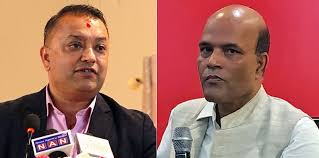
Sarlahi 4 was never supposed to be dramatic this time. That changed the moment Gagan Thapa decided to leave his safe Kathmandu seat and enter a constituency long dominated by Amresh Kumar Singh. Singh has won here three times and had grown used to treating the seat as personal property. Thapa’s arrival has disturbed that comfort and turned the race into one of the most watched contests in the Madhesh.
The contrast between the two candidates is sharp. Thapa is the Nepali Congress chair and the party’s declared prime ministerial face. His candidacy carries national weight, media attention, and a sense that voters here can directly influence who leads the next government. Singh’s position looks weaker by comparison. A new entrant to the Rastriya Swatantra Party, he does not enjoy the same standing inside his party. RSP has not projected him as a national leader, nor has it framed him as a future prime minister. For many voters, this difference matters.
Thapa’s move is not only personal ambition. It reflects a broader Congress strategy. Sarlahi lies at the heart of Madhesh Province. A strong result here can shape outcomes in Bara, Parsa, Mahottari, and Dhanusha. The Tarai Madhesh belt has often supported the Congress, except during the 2008 Constituent Assembly election. The party, though, failed to build lasting trust. After Girija Prasad Koirala, few Congress leaders invested time in understanding Madhesh politics or managing ties with India. Thapa’s entry signals an attempt to correct that neglect and rebuild influence from the ground up.
Singh’s record complicates his defense. As a three-time MP, he has raised several national issues in Parliament and built an image as a sharp speaker. Local voters, though, point to gaps. Unemployment remains severe despite a relatively educated population. Major infrastructure projects, including the Sarlahi–Rautahat bridge over the Bagmati River and bridges over the Manushmara River, remain unfinished. Singh’s critics argue that repeated victories brought little change to daily life. His shift to RSP has added another layer of uncertainty, as the party’s local structure in Sarlahi 4 remains thin.
The field is not limited to these two. Rameshwar Rai Yadav of JSP Nepal is a seasoned figure with roots in the Nepal Sadbhavana Party. A former National Assembly member and labor minister, Yadav understands the constituency well. His problem lies in arithmetic. Multiple Yadav candidates in the race increase the chance of vote division. Even with JSP holding ten ward chairs, converting organizational strength into a winning tally will be hard.
Local data shapes expectations. Sarlahi 4 includes 51 wards across several municipalities. In the 2022 local elections, Nepali Congress led in 19 wards, ahead of Maoist Center, UML, LSP, and JSP. In the last general election, Singh won as an independent with a narrow margin over the Congress candidate. Provincial seats remain split between Congress and Maoist Center. These numbers suggest Congress enters this race with a stronger base than before.
Demographics add another layer. Nearly 40 percent of voters fall between 16 and 40 years of age. Youth frustration with old parties runs deep. RSP draws attention among younger voters, though much of that interest appears tied to personalities rather than party depth. Many doubt that curiosity alone will convert into votes for Singh.
Caste still influences outcomes. Yadavs form the largest bloc, followed by upper caste Tarai groups including Bhumihar Brahmins and Rajputs. Dalits account for a significant share. History shows voters here hesitate to defeat leaders with national stature. That pattern favors Thapa more than Singh.
With divided votes among Yadav candidates, unresolved local issues, and a clear difference in national standing, Thapa enters Sarlahi 4 as more than a challenger. He offers voters a chance to link local choice with national power. Singh still commands loyalty, yet this time the ground feels less certain beneath him. The contest remains open, though the momentum has shifted. In Sarlahi 4, the fight is no longer routine. It is personal, political, and closely watched far beyond the district.






Comments:
Leave a Reply